| |
|
Stream Entomology
Fly Fishing Entomology: Part
1
by
Eugene P. Macri Jr.

You may use these articles. You can store them. You can
read them. You may not change, republish, sell or redistribute these articles in anyway for any monetary
gain. You may not add them to your collection and sell them etc. These articles are copyrighted
and we will strictly enforce the copyright.
© 2006 E. P. Macri Jr.
Basic Mayfly Anatomy
In our continuing series on entomology we discussed the families of
mayflies in our last issue. In this issue let's review the basic anatomy of the mayfly in both the nymph (larva)
and adult stages. Please refer to the diagrams elsewhere in this article to aid you in his
discussion.
The mayfly nymph
(larva) body consists of three main parts: head, thorax and abdomen. We know that mayflies are insects, and
therefore possess three pair of jointed legs on the underside of the thorax. On the head of a mayfly nymph are
found two compound eyes and usually three simple eyes or ocelli (ocellus: singular). The compound eyes are located
laterally or dorsally. In mature nymphs the male's eyes will be larger in most species. The shape of the head will
vary with the genera of mayfly. A pair of antennae are present on the head also. They will vary in size dependent
on the genera also.The thorax consists of three parts: prothorax, mesothorax, and the metathorax. The dorsal
surface (top) is named accordingly with these three parts as the pronotum, mesonotum, and metanotum. These hardened
dorsal plates are sometimes referred to as 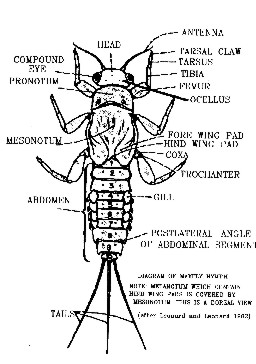 sclerites. Each of the three parts, the prothorax,
mesothorax, and metathorax contain one pair of legs. Each leg consists of a coma, trochanter, femur, tibia and
tarsal claw. The shape of each of these parts will vary with the function of the leg in each group of
mayflies. The legs will contain spines, setae and variety of projections in different species. The largest
part of the thorax is the mesonotum, which contains the fore wingpads. The mesonotum sometimes conceals the
metanotum which contain the hind wing pads. The abdomen of the mayfly consists of ten segments. The abdomen
often has spines and tubercles (small knoblike or rounded projections). All ten segments may not be visible.
The mesonotom may conceal the first couple in some species. The dorsal surface of the abdomen (or any body
segment) is often called a tergum (terga plural). On the abdomen of mayflies the shape of the terga sclerites. Each of the three parts, the prothorax,
mesothorax, and metathorax contain one pair of legs. Each leg consists of a coma, trochanter, femur, tibia and
tarsal claw. The shape of each of these parts will vary with the function of the leg in each group of
mayflies. The legs will contain spines, setae and variety of projections in different species. The largest
part of the thorax is the mesonotum, which contains the fore wingpads. The mesonotum sometimes conceals the
metanotum which contain the hind wing pads. The abdomen of the mayfly consists of ten segments. The abdomen
often has spines and tubercles (small knoblike or rounded projections). All ten segments may not be visible.
The mesonotom may conceal the first couple in some species. The dorsal surface of the abdomen (or any body
segment) is often called a tergum (terga plural). On the abdomen of mayflies the shape of the terga
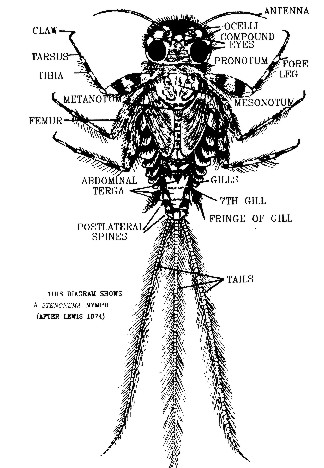 are used in identification. The ventral (belly,
bottom or underneath) sclerites of the abdomen are called sterna (sternum: singular); and their shape aids in
identification purposes.The variable gills of the mayfly are usually found on the abdomen. In some species
like Isonychia they are also found at the base of coxae. In most mayflies the gills are lateral or dorsal.
However, in some species they will be ventral. Their presence or absence on certain abdominal segments is also
used for identification. Gills are extremely variable in shape, size and appearance dependent on species.
Tails (Caudal filaments): most mayflies have three tails; some have two. Entomologists refer to these as a
terminal filament and two cerci. For our purposes tails are fine (cerci are nothing more than a pair of
appendages at the posterior end of the abdomen)! are used in identification. The ventral (belly,
bottom or underneath) sclerites of the abdomen are called sterna (sternum: singular); and their shape aids in
identification purposes.The variable gills of the mayfly are usually found on the abdomen. In some species
like Isonychia they are also found at the base of coxae. In most mayflies the gills are lateral or dorsal.
However, in some species they will be ventral. Their presence or absence on certain abdominal segments is also
used for identification. Gills are extremely variable in shape, size and appearance dependent on species.
Tails (Caudal filaments): most mayflies have three tails; some have two. Entomologists refer to these as a
terminal filament and two cerci. For our purposes tails are fine (cerci are nothing more than a pair of
appendages at the posterior end of the abdomen)!
Adults: The head of the adults contain the compound eyes
which are usually larger in the male. This is true with the exception of Tricorythidae and Caenidae. In these
two families there is no difference in the size of the eyes. In Baetidae (Blue Winged Olives) and
Leptophlebiidae the upper facets are raised or stalked (called turbinate). Facets refer to the external
surface of the compound eye. The male eyes are all one color or the upper area may be another color. In some
males the eyes will change color with light intensity and duration (Stenonema) There are two antennae and
three ocelli The mouth parts in the adult are vestigial and are useless. Adult mayflies cannot take in any
food thus their short adult life is for reproduction only.The thorax consists of the same three regions as
the nymph. The prothorax contains the forelegs (in some males the eyes may be so large as to partially
conceal this section). The mesothorax contain the middle pair of legs and the fore wings. The metathorax
contain the third pair of legs, and the hind wings if they are present. In most mayflies the male forelegs
are longer than the female (called sexual dimorphism). The female's forelegs are about the same size as the
middle and hind legs. Each leg of the mayfly has the same six parts as the nymph. However, the legs are now
modified for their short adult existence. The coxa is very wide and large and forms the strength of the leg.
Next is a small trochanter, a flat femur, slender tarsus and tibia, and apical
claws.
Most mayflies have
two pair of wings. Some only have one or the hind wings are reduced in size. The fore wings are nearly triangular
in most mayflies. The veins in the wings give the wings structure and flexibility. The veins are hollow and usually
contain trachea, nerves and blood. The characteristic patterns of the imago wings is useful in identification
purposes. The veins are labeled by entomologists for taxonomic purposes. However, there is a great deal of
disagreement in naming the 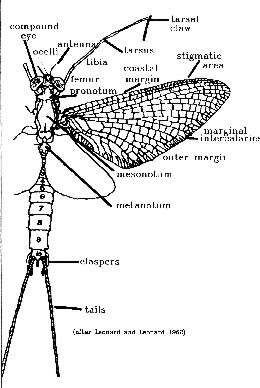 longitudinal and cross veins. Please check the
diagrams for aid in using the veins for identification. We are using the system developed by Edmunds and
Traver. longitudinal and cross veins. Please check the
diagrams for aid in using the veins for identification. We are using the system developed by Edmunds and
Traver.
The abdomen
consists of ten segments with the last segment containing the caudal filaments. Some mayflies have two caudal
filaments (cerci) while others have three. In segment 9, the sternum forms a plate containing a pair of forceps in
the males. In the female the ninth segment again forms the reproductive structure but there are no claspers or
penes. The male penes is sometimes fused in some species. The penes may contain spikes and other processes. The
male imago genitalia is the single most reliable trait in the identification of species in mayflies.
I hope this introduction to mayflies has been helpful. Please refer to the diagrams
when reading this discussion.
|
|
|
|
